“What is GST? GST, or Goods and Services Tax, is a unified indirect tax system introduced in India to replace multiple taxes such as VAT, service tax, and excise duty. It is charged on goods and services and helps create a simple, transparent, and efficient taxation system across the countr
What is GST? Introduction to GST in India
GST, or Goods and Services Tax, is one of the biggest tax reforms introduced in India. It was launched on 1 July 2017 to make the taxation system simple and transparent. Before GST, different taxes were charged by the central and state governments, which made the system complicated for businesses and consumers. GST replaced many indirect taxes and created a single tax system across the country.
Today, GST is applied on almost every product and service we use in daily life, such as clothes, food items, mobile phones, restaurant bills, online shopping, transport services, and many more. Whenever you buy something or pay for a service, a small amount of GST is included in the final bill.
This article explains GST in easy language, including its meaning, types, advantages, disadvantages, and how it works in India.
“Many people search for what is GST because it affects almost every product and service used in daily life.”
What is GST?
GST stands for Goods and Services Tax. It is an indirect tax charged on the supply of goods and services. The tax is paid by consumers, while businesses collect it and deposit it with the government.
In simple words, GST is a single tax system that replaced many old taxes like:
- VAT (Value Added Tax)
- Service Tax
- Excise Duty
- Entry Tax
- Luxury Tax
- Entertainment Tax
Earlier, businesses had to pay different taxes at different stages, which increased confusion and paperwork. GST simplified this process by introducing one unified tax system.
The main goal of GST is “One Nation, One Tax.”
Why Was GST Introduced in India?
Before GST, India had a complicated tax structure. Different states had different tax rules, and businesses faced many problems while selling products across states.
Some major problems before GST were:
- Multiple taxes on one product
- Complex tax calculations
- Higher prices due to tax on tax
- Difficult tax filing process
- Lack of transparency
To solve these issues, the Government of India introduced GST. It created a common national market and made taxation easier for businesses and consumers.
What is GST and How Does It Work?
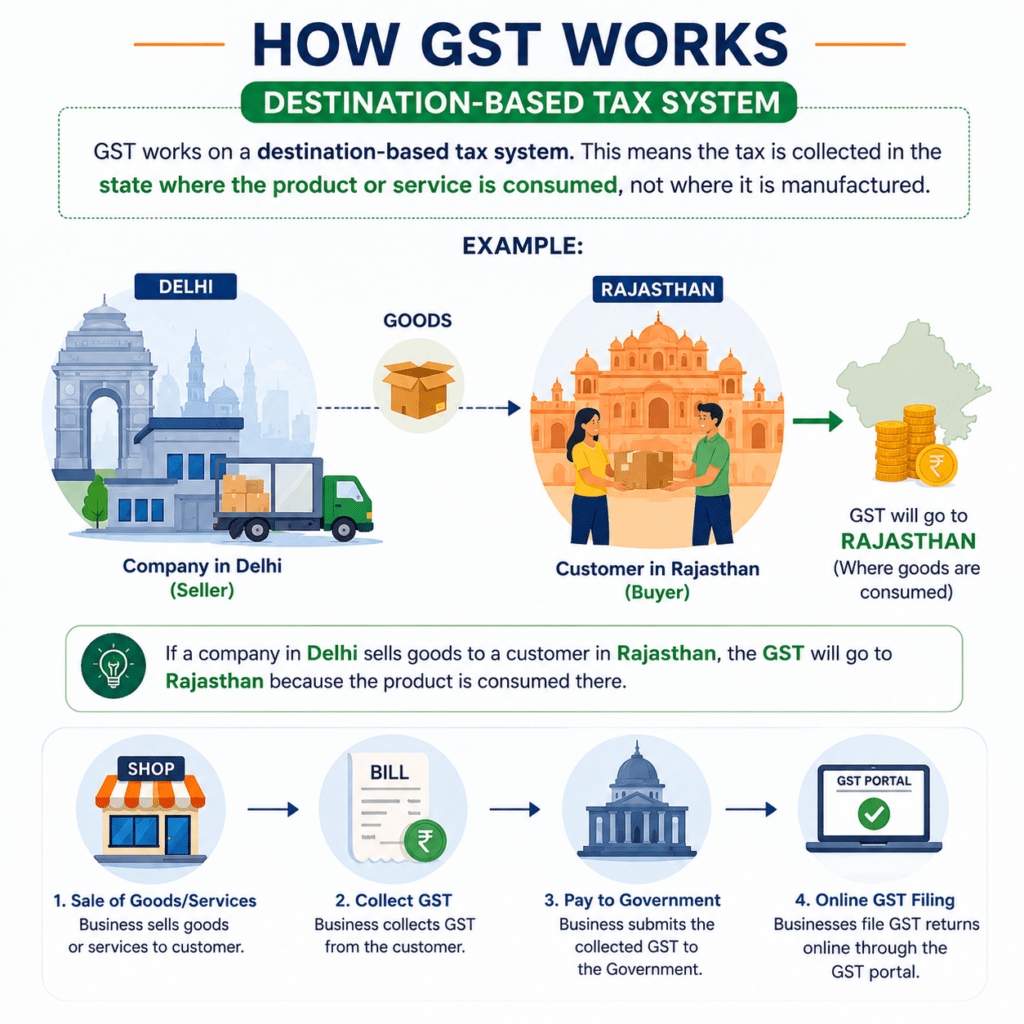
GST works on a destination-based tax system. This means the tax is collected in the state where the product or service is consumed, not where it is manufactured.
For example:
If a company in Delhi sells goods to a customer in Rajasthan, the GST will go to Rajasthan because the product is consumed there.
Businesses collect GST from customers during sales and then submit it to the government through online GST filing.
Types of GST in India Explained
GST in India is divided into four types:
1. CGST (Central Goods and Services Tax)
CGST is collected by the Central Government on sales within the same state.
Example:
If goods are sold within Rajasthan, the central government receives CGST.
2. SGST (State Goods and Services Tax)
SGST is collected by the State Government on sales within the same state.
Example:
When a product is sold inside Rajasthan, the Rajasthan government receives SGST.
3. IGST (Integrated Goods and Services Tax)
IGST is charged on interstate sales, meaning when goods move from one state to another.
Example:
Goods sold from Delhi to Maharashtra attract IGST.
4. UTGST (Union Territory Goods and Services Tax)
UTGST applies to Union Territories like Chandigarh, Lakshadweep, and Andaman & Nicobar Islands.
GST Tax Slabs in India
GST is charged at different rates depending on the type of product or service.
The main GST slabs are:
| GST Rate | Products/Services |
|---|---|
| 0% | Essential food items |
| 5% | Household necessities |
| 12% | Processed foods, medicines |
| 18% | Electronics, restaurants |
| 28% | Luxury items, premium products |
Some products like petroleum and alcohol are currently outside GST.
Advantages of GST in India
GST offers many benefits for businesses, consumers, and the economy.
1. Simple Tax System
GST replaced multiple taxes with one tax system, making taxation easier to understand.
2. Reduced Tax Burden
Earlier, tax was charged on tax, increasing product prices. GST removed this problem and reduced the overall tax burden.
3. Easy Online Filing
Businesses can register, file returns, and pay taxes online through the GST portal. This saves time and paperwork.
4. Better Transparency
GST improved transparency because every transaction is recorded digitally.
5. Boost to Business Growth
GST created a unified national market, helping businesses sell products across India more easily.
6. Increased Government Revenue
Because GST is digital and transparent, tax evasion has reduced, increasing government revenue.
Disadvantages of GST
Although GST has many benefits, it also has some disadvantages.
1. Complex for Small Businesses
Small businesses sometimes find GST filing difficult because of online procedures and regular return filing.
2. Increased Compliance
Businesses must maintain proper invoices and file returns regularly.
3. Internet Dependency
Since GST works online, businesses in rural areas may face difficulties due to poor internet connectivity.
4. Frequent Rule Changes
GST rules and rates are updated regularly, which can create confusion.
Who Needs GST Registration?
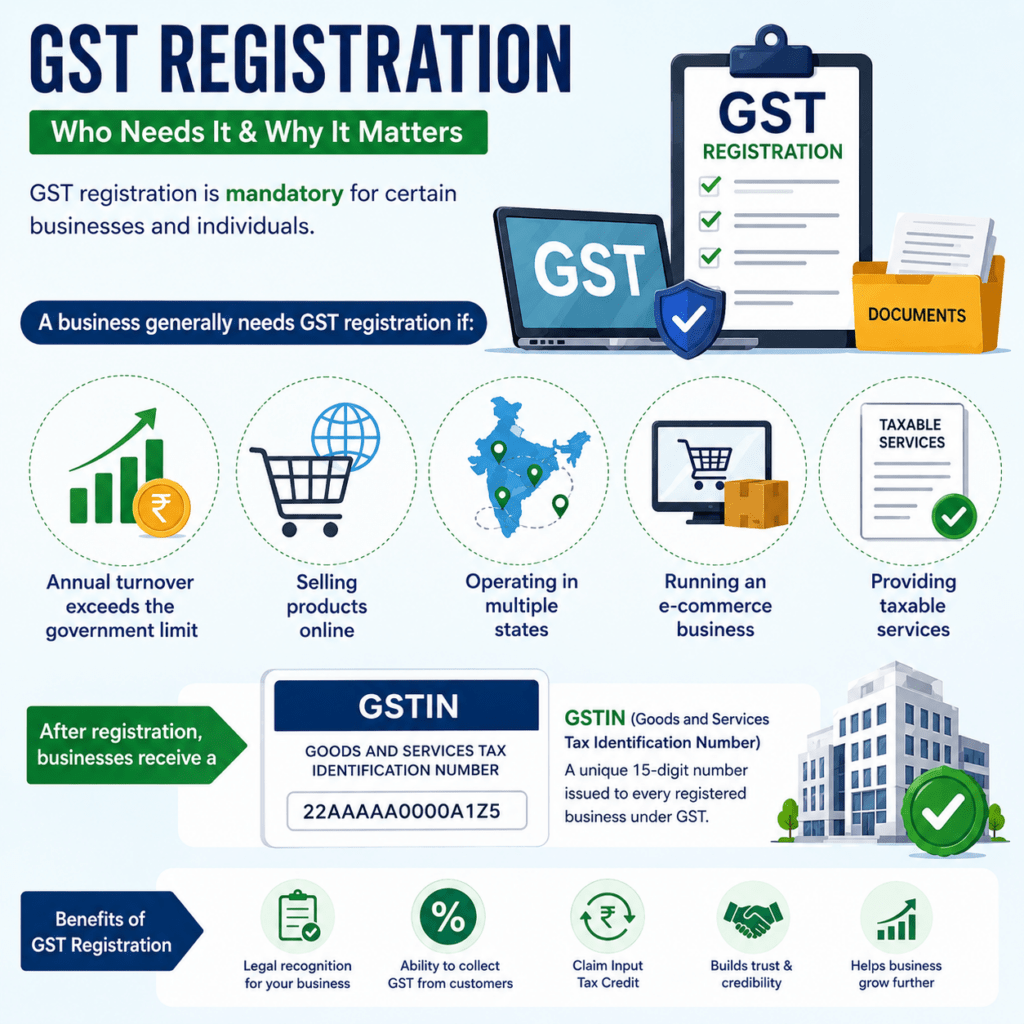
GST registration is mandatory for certain businesses and individuals.
A business generally needs GST registration if:
- Annual turnover exceeds the government limit
- Selling products online
- Operating in multiple states
- Running an e-commerce business
- Providing taxable services
After registration, businesses receive a GSTIN (Goods and Services Tax Identification Number).
What is GSTIN?
GSTIN stands for Goods and Services Tax Identification Number. It is a unique 15-digit number given to every registered taxpayer under GST.
Businesses use GSTIN for:
- Filing GST returns
- Paying taxes
- Creating invoices
- Claiming input tax credit
What is Input Tax Credit (ITC)?
Input Tax Credit is one of the biggest advantages of GST.
It allows businesses to reduce the tax they already paid on purchases from the tax they need to pay on sales.
Example:
- A shopkeeper buys goods and pays ₹100 GST.
- Later, he sells the goods and collects ₹150 GST from customers.
- He only needs to pay ₹50 to the government because ₹100 is already paid earlier.
This system prevents double taxation.
GST Return Filing
Businesses registered under GST must file returns regularly.
GST returns contain details such as:
- Sales
- Purchases
- Tax collected
- Tax paid
Returns are filed online through the official GST portal.
Timely filing is important to avoid penalties.
What is GST Impact on Consumers?
GST directly affects consumers because it is included in product prices.
Some products became cheaper after GST, while some became slightly expensive depending on the tax slab.
Consumers benefit because:
- Bills are more transparent
- Hidden taxes are reduced
- The tax structure is simpler
Whenever you receive a bill from a restaurant, shop, or online platform, you can see the GST amount separately mentioned.
GST and Small Businesses
GST has changed the way small businesses operate.
Benefits for small businesses include:
- Easier interstate trade
- Online registration process
- Better tax credit system
- Increased business opportunities
However, some small businesses initially faced challenges in understanding the online system and compliance requirements.
Impact of GST on the Indian Economy
GST has had a major impact on India’s economy.
Some positive effects include:
- Improved tax collection
- Better transparency
- Reduced corruption
- Growth in organized businesses
- Easier movement of goods across states
GST also supports the Digital India initiative because most processes are online.
Challenges Faced During GST Implementation
When GST was introduced, businesses faced several challenges such as:
- Understanding new rules
- Technical issues on the portal
- Frequent changes in return filing
- Need for accounting software
Over time, businesses gradually adapted to the new system.
Future of GST in India
The government continues improving the GST system by simplifying rules and introducing digital solutions.
In the future, GST may become even more user-friendly with:
- Simplified return filing
- Faster refunds
- Better technology integration
- Reduced compliance burden
Experts believe GST will continue strengthening India’s economy and business environment.
“To understand India’s taxation system properly, it is important to learn what is GST and how it works.”
Conclusion
GST is an important tax reform “Understanding what is GST helps businesses, students, and consumers understand the modern tax system in India.”
that transformed India’s taxation system. It replaced multiple indirect taxes with a single unified tax structure, making taxation simpler and more transparent.
GST benefits both businesses and consumers by reducing tax complexity, improving transparency, and supporting economic growth. Although there are some challenges, GST has helped create a modern and organized tax system in India.
Understanding GST is important because it affects almost every product and service we use daily. As India’s economy grows, GST will continue playing a major role in improving business operations and tax management across the country.
- In conclusion, GST has transformed India’s taxation system by replacing multiple indirect taxes with one unified tax. It has made the tax process more transparent, simple, and efficient for businesses and consumers. Understanding what is GST helps people know how taxes work and how GST contributes to the growth of the economy.
- To sum up, GST is an important tax reform that has simplified the way goods and services are taxed in India. It reduces tax complications, improves business operations, and creates a smooth taxation system across the country. Learning what is GST is essential for every business owner, student, and consumer today.
https://cadineshsoni.com/income-tax-return-filing-services/?utm_source=chatgpt.com